The Ultimate Guide to Writing a Letter
In a single notebook by my desk, I keep a running list of letters I meant to write.
The Christmas letter to my Aunt Lou I forgot for three years running. The condolence note to my friend Maya's father after her mother died in 2024. The thank-you to my high school swimming coach, the second-grade teacher who sat with me at lunch to help me focus and catch up on work (ADD didn't exist back then, especially not for smart girls).
The pile of letters I have meant to write is taller than the pile I have sent.
A letter you write is heavier than a letter you mean to write.
This guide is the one I go to when I want motivation in writing that next letter.
In this guide
- Why handwritten letters still matter
- The anatomy of a personal letter
- The 12 letters worth writing
- What to write when you don't know what to say
- Finding your voice on paper
- The art of decorating letters and envelopes
- Stationery, paper, and pens that make a difference
- How to start a letter writing habit
- Handwritten vs typed vs email
- Common letter writing mistakes
- Frequently asked questions
Why handwritten letters still matter
First-class mail has fallen from a peak of 213 billion pieces in 2006 to under 113 billion in 2024. Letter mail specifically, the personal letters from one person to another, is a small fraction of that. Most adults under thirty have never received a real letter from a friend.
That is precisely why a letter is magical!
When something becomes rare, it becomes signal. A handwritten letter says: I sat down for half an hour, I held a pen, I thought about you, I paid for a stamp.
I care about you.
Research on writing by hand suggests something else, too. Mueller and Oppenheimer's 2014 study found that people who write longhand process information more deeply and remember it longer than people who type. Newer research from Audrey van der Meer's lab at NTNU shows handwriting activates broader networks in the brain than typing does.
You don't write a letter because it's efficient. You write it because the inefficiency is the point.
Letter writing has also quietly become a kind of self-care for the people who do it. The slowness, the ritual, the paper under your hand: why snail mail is the self-care ritual you didn't know you needed.
The anatomy of a personal letter
What are the parts of a personal letter?
A personal letter has six parts: the date in the upper right, the greeting on the left, an opening line that says why you are writing, the body where you say the thing, a closing that signals the letter is ending, and your signature. That is the whole shape. There is no formula and no required tone, but the six parts give the letter scaffolding.
See our guide to the parts of a personal letter.
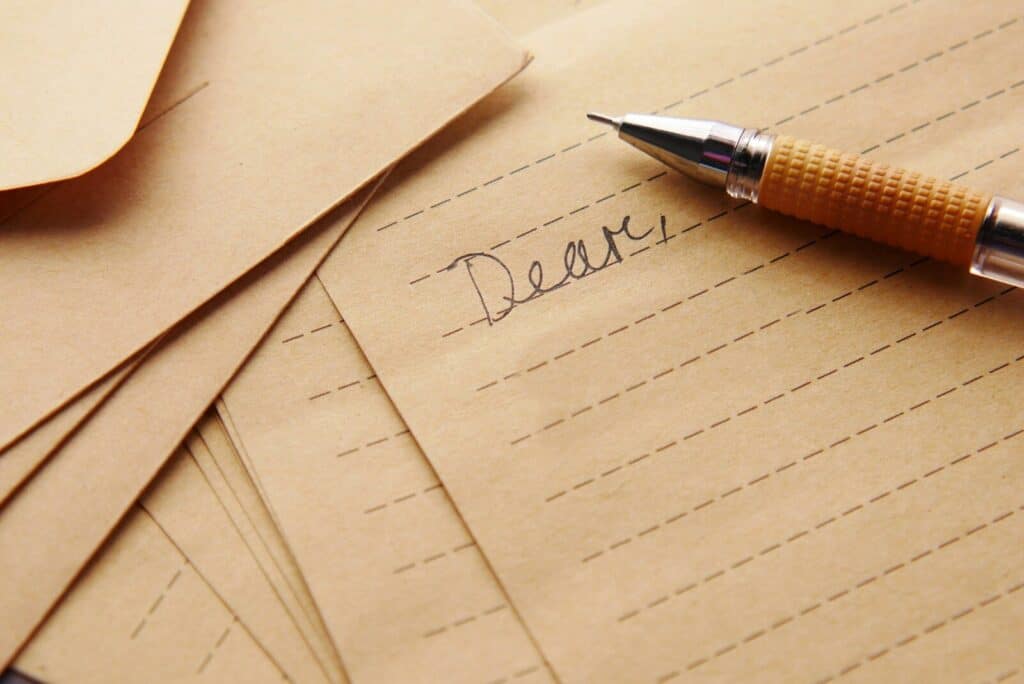
The opening line is the one most people fumble. New letter writers reach for "I hope this finds you well," which is the postal-mail equivalent of "Hi, how are you" at the start of a text. It's polite, it's filler, it tells the reader nothing about why they're holding this letter.
A better opening names the moment of writing. "It's raining and I'm thinking of you." "I found your old letter in a box this morning." "I have been meaning to send this for two years."
The closing is the second easiest to overthink. "Sincerely" is fine. So is "Love," "With love," "Yours," "Always," or the one I use most, "Your friend." Match the closeness of the relationship. Don't sign off "Sincerely" to your best friend or "Love" to your dentist.
The signature is yours. Sign it with whatever name the person calls you.
The 12 letters worth writing
The shape of a letter changes with its purpose. A sympathy letter is not a love letter. A fan letter is not a thank-you. Below are the twelve kinds of letters most worth writing in a life, organized by what they're for. Each links to a full how-to.
Letters for friendship and connection:
- How to write a letter to a friend (even when nothing big has happened)
- How to write a letter that says "thinking of you"
- How to write a letter to a teacher or mentor who changed your life
Letters for big feelings:
- How to write a love letter that means something
- How to write a goodbye letter to a friend that honors a friendship
- How to write a sympathy letter instead of sending a text
Letters for celebration:
- How to write a thank you letter that makes someone's day
- How to write a fan letter (without feeling weird about it)
- How to write a congratulations letter instead of a text
- How to write an anniversary letter
- How to write a Christmas letter people actually want to read
Letters for care:
And if you’d like someone new to write to, here is how to find a pen pal as an adult.
If you don't know which to start with, write a thank-you. They land harder than anyone expects.
What to write when you don't know what to say
The page is empty. The person is in your head. The pen feels too heavy. Here are five questions that almost always unlock the letter. Answer three of them and the letter writes itself.
1. What made me think of you today?
A song. A smell. A book. A thing someone said that reminded me of something we used to laugh about. Naming the specific trigger is enough on its own. "I was in the produce aisle this morning and the cardboard sign said 'tomatoes' and I remembered your tomato tart."
2. What have you been carrying that I haven't asked about?
Most people are carrying something nobody asks about. Acknowledging the carrying is half the letter.
3. What do I wish I had said the last time?
The thing you thought of in the car, three hours after you saw them.
4. What is small in my life right now that you would want to hear about?
Not the milestone. Not the achievement. The Tuesday. The good loaf of bread. The weather. The honest texture of your week.
5. What would I want to read from you?
Write that.
If those five aren't enough, our list of 50 letter writing prompts for when you're staring at a blank page breaks it down further by recipient.
Finding your voice on paper
How do I find my voice when writing letters?
Your voice is already in your texts, in your voicemails, in the way you talk to the friends who know you. Letter-writing voice is the same voice, slowed down. The biggest mistake new letter writers make is reaching for a "letter-writing voice" that doesn't actually exist: a kind of greeting-card formality nobody talks in. Don't. Write the way you'd speak if the room were quiet. Our guide to finding your tone in letter writing walks through how.
A small test: read the letter aloud after you write it. If you wouldn't say any of those sentences in person to that person, rewrite that sentence.
The other test: pick three small details. A song you heard, a thing you saw, a thing someone said that reminded you of them. Use specifics. Specifics carry the voice. Abstractions kill it.
The art of decorating letters and envelopes
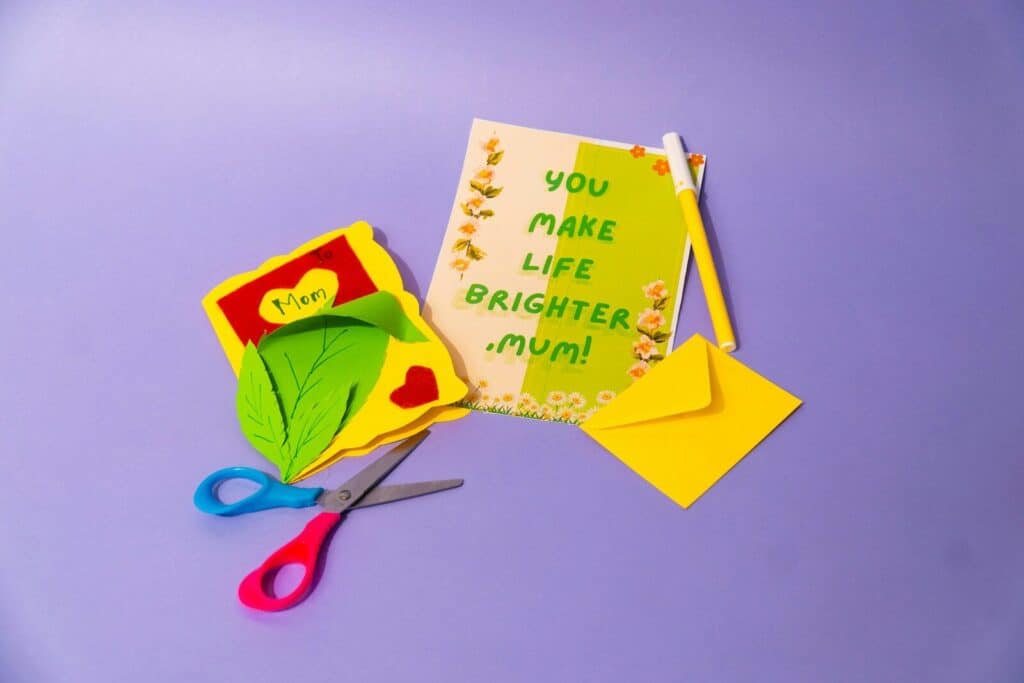
A letter is also a physical object. Some people write the words and stop there. Others turn the envelope into a small piece of art: hand-lettered addresses, wax seals in colors that match the season, washi tape down the back flap, a drawing of a bird in the corner where the stamp goes.
The history of mail art is wild and worth knowing. People have been making envelopes into canvases since the 1960s, with one specific movement, Ray Johnson's New York Correspondance School, inventing the whole genre. Letters of Note keeps an archive of historical correspondence worth losing an afternoon to. The Slow Mail Society Substack also runs a series on the wild, bloody, and rebellious history of mail art if you want the full strange story.
For practical decoration, see how to decorate letters and envelopes (no art skills required). For something more collaborative, where the letter travels through multiple hands and gets added to before it reaches its final recipient, see what is a chain mail art letter and how to make one.
You don't have to decorate anything. A plain letter in a plain envelope, addressed in your own handwriting, is enough. The decorating is dessert.
Stationery, paper, and pens that make a difference
What kind of paper should I use to write a letter?
You don't need fancy paper to write a good letter. The best paper is the one you'll actually write on. That said, paper does have weight and texture and tooth, and those small physical qualities change how the letter feels in the recipient's hand. For most personal letters, 80 to 120 gsm cream or white paper in either A5 or letter size is a safe, beautiful default. Heavier than copy paper, lighter than cardstock.
None of it is required. But paper with a little weight and a pen that does not skip turn the act from a chore into something you look forward to.
A note on stamps: buy the prettiest ones the post office is selling. It costs the same as a flag stamp and changes the whole letter.
How to start a letter-writing habit
How do I build a letter-writing habit?
The smallest habit that sticks is one letter a week, written at the same time every week. Sunday afternoon while the coffee is still warm. Tuesday at nine. Whatever rhythm your week allows. Start with one person. Don't try to write to everyone you have ever lost touch with in the same month. Full breakdown in how to start a letter writing habit you'll actually keep
Three rules that help:
Same time every week. The brain needs a slot.
One page per letter. Don't aim for three pages. A single page is enough.
A small ritual at the start. Tea, a candle, a specific song, the same chair. The ritual is the on-ramp.
If you want help with the rhythm, the Mail Club Hub Monthly sends a monthly letter-writing prompt along with new clubs to discover. One prompt, one letter, one mailed envelope a month.
Handwritten vs typed vs email
Do you have to handwrite a letter?
No, not always. There are letters that work typed: long essays to family members, anything legal-adjacent, anything you need to keep a copy of. Most personal letters benefit from being handwritten because the handwriting itself carries information about you that no font can replicate. The wobble at the end of a tired evening. The shape of your S. The smudge where your hand dragged across the wet ink. Our full comparison covers when each format is right in should you handwrite, type, or email your letter.
A reasonable rule: if the letter is long, you can type it. If the letter is for someone you love, write it by hand.
Common letter-writing mistakes
The mistakes we letter writers make are almost always the same. We start too formal. We apologize for not writing sooner. We explain too much. We try to be profound. We forget the actual person they're writing to and start writing into the air. Full list, with how to get past each one, in 10 letter writing mistakes and how to get past them.
The single most fixable mistake is apologizing for the gap. "Sorry I haven't written" buys nothing. The person is glad you wrote now. Skip the apology and tell them why you're writing today.
Frequently asked questions
Is letter writing still relevant in 2026?
Yes, arguably more so than in twenty years. Mail volume is at historic lows, which means a real letter now stands out more than it ever did. A handwritten note is one of the rarest things a person can receive. The cultural moment has also turned: TikTok #SnailMail has 150,000+ posts, Pinterest's 2026 trend report predicts a "letter-writing renaissance," and Gen Z is rediscovering the practice.
How long should a personal letter be?
One handwritten page is the sweet spot. Enough room to say something specific without becoming a chore to read. Two pages is also fine for closer relationships or weightier moments. Three pages and up is reserved for the rare letter that genuinely needs the length. The recipient does not care how long the letter is. They care that you wrote it.
Do I need to write in cursive?
No. Print is fine. Mixed print and cursive is fine. The most-loved letters in most people's lives were written in whatever script came naturally to the sender. Legibility matters more than style. If your handwriting is hard to read, slow down and write larger; that solves most of it.
Where do I find pen pals?
Several places. International pen pal organizations like International Pen Friends and Postcrossing match adults globally. Substack has a growing community of people who write monthly letters and trade addresses. Reddit has r/penpals and r/snailmail. Our full guide on how to find a pen pal as an adult walks through the safest and warmest options.
What if my handwriting is bad?
Write slower. Write larger. Use lined paper if it helps you stay straight. Beyond that, embrace it. Handwriting carries voice; "perfect" handwriting often reads as cold. The wobble is part of the letter.
Should I make a copy of a letter before sending it?
For most personal letters, no. The letter is for the recipient. Letting it go is part of the gift. For letters with practical or sentimental significance you might want to remember (a final letter to someone, a once-in-a-lifetime apology, a love letter you put real work into), take a phone photo of the pages before sealing the envelope. That's enough.
How do I address an envelope properly?
Recipient's name and address centered on the front, lower-middle of the envelope. Your return address upper-left. Stamp upper-right. Write the address by hand if your handwriting is legible; otherwise print clearly. Full visual breakdown in our guide to the parts of a personal letter.
A small invitation
Writing a letter does not require fancy paper or the perfect words or a free Saturday. It requires a piece of paper, a pen, an address, a stamp, and you, choosing to do it.
Start with one letter this week. Pick the smallest one on your wall of unwritten letters. The thank-you. The thinking-of-you. The one whose recipient won't see it coming.
If you'd like a quiet monthly nudge to keep going, the Mail Club Hub Monthly lands in your inbox once a month with new mail clubs, hidden gems, and a fresh letter writing prompt. A free printable Address Book and Mail Log comes with the signup, to help you track the letters you've sent and the letters you mean to send next.
The letters you have been meaning to write have been waiting for you.
Your friend and fellow letter lover,
K. Larkin 💌